
Start with a category ابدأ من هنا
Home Guides, Kitchen guides
How to Stop a Cutting Board From Slipping on the Counter
14
Nov
Nov
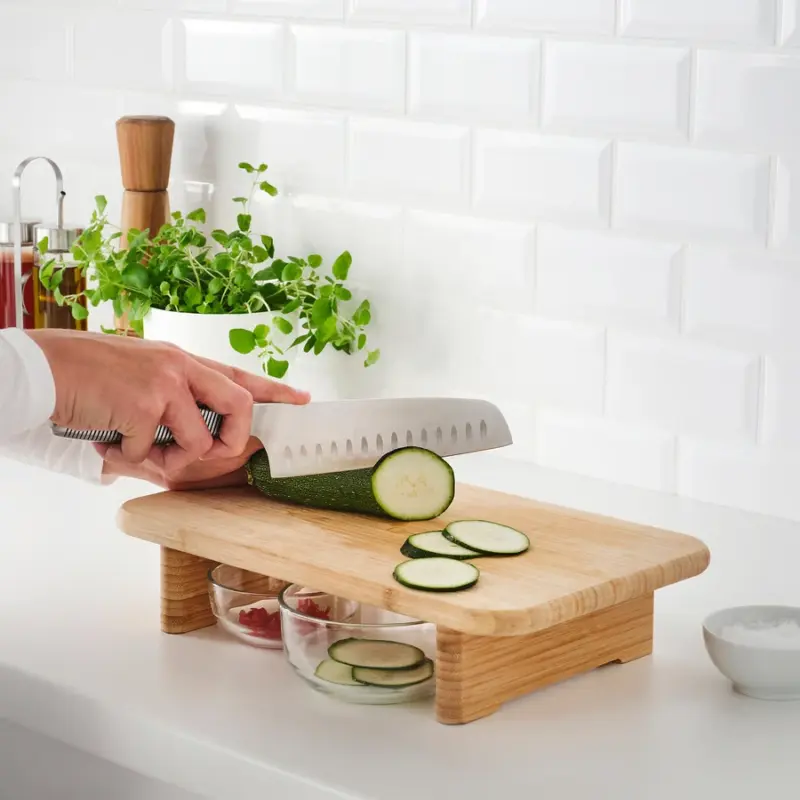
Quick answerA cutting board slips because it sits flat on a smooth, often wet counter. A wooden board raised on legs stays steady while you chop, sits at a more comfortable working height and lifts the board off the wet surface. After prep, the same board works as a breakfast in bed tray or a serving board for cheese and appetizers.
In this guide
Why cutting boards slide around
Every home cook knows the moment: you press the knife into an onion and the whole board shifts a few centimetres. Most Egyptian kitchens have marble or granite counters, which are smooth and often wet from washing vegetables. A flat board sits directly on that surface, and a thin layer of water is enough to make it glide.
A sliding board is more than annoying. It is how knives slip and fingers get cut. People try to fix it with a damp towel underneath, which works for a while and then turns into a soggy cloth that smells by the end of the day. Others hold the board with one hand while they chop with the other, which slows everything down.
The better fix is a board that does not sit flat on the wet counter in the first place.
How a board with legs fixes it
A wooden cutting board raised on legs changes three things at once:
- It stays steady. The legs keep the board from slipping while you chop, so your knife goes where you aim it
- It sits higher. The raised board gives you a more comfortable working height, so you bend less over long prep sessions
- It stays off the wet surface. Water on the counter no longer sits under the board, so it does not slide on it
Made of durable wood and easy to clean, it handles daily chopping of vegetables, herbs, bread and fruit, the jobs that happen in every Egyptian kitchen several times a day.

From Cairo HubsWooden Cutting Board with Legs and Serving Tray Original price was: 332 EGP.255 EGPCurrent price is: 255 EGP.Add to cartView product
Set up a safe chopping station
- Clear a space. Give the board a clear area on the counter, away from the stove and the edge, so nothing knocks into you while you work.
- Dry the counter. Wipe the spot where the board goes. Even with legs, a dry surface is the safest base.
- Bring everything to the board. Wash the vegetables, then put them on one side and an empty bowl on the other. You chop in the middle and move straight into the bowl.
- Use a sharp knife. A blunt knife needs more force and slips more easily. Sharpen it regularly.
- Keep fingers curled. Hold food with your fingertips tucked in, so the knife rests against your knuckles and not your fingertips.
- Clear as you go. Push peels and offcuts into a small bin or bowl after each vegetable, so the board stays clear.
Tip: Keep your knives, spatulas and wooden spoons in a holder right next to the board. When every tool is within reach, you stop walking back and forth across the kitchen.

From Cairo HubsWooden Kitchen Utensil Holder, 3 Compartments Original price was: 332 EGP.255 EGPCurrent price is: 255 EGP.Add to cartView product
From cutting board to serving tray
The raised design is not only for chopping. Because the board stands on its own legs, it doubles as a small table or tray.
- Breakfast in bed: set it over your lap with tea, a plate of eggs and some bread on a Friday morning
- Cheese and appetizers: serve white cheese, olives, cut vegetables and bread for guests straight on the board
- Evening snacks: fruit, nuts or sandwiches in front of the TV without needing a side table
- Sahur and iftar: a quick spread of dates, cheese and bread in the living room
Pair it with a set of glass cups and the board becomes a full serving tray. Tea for two, juice for guests, or water with breakfast all sit neatly on one piece of wood.

From Cairo HubsAmber Crystal Glass Cups, Set of 6 Original price was: 410 EGP.315 EGPCurrent price is: 315 EGP.Add to cartView product
Look after a wooden board
Wood lasts for years when you treat it right. A few habits keep it clean and in shape:
- Wash it by hand with warm water and a little dish soap straight after use
- Do not leave it soaking in the sink. Long contact with water can warp wood
- Dry it with a towel, then let it air dry standing up
- Wash it well with soap after raw meat or chicken before you cut anything else on it
- Rub it now and then with a little food safe oil to keep the wood from drying out
- Use one side for chopping and keep the other side clean for serving
For more ideas to make your kitchen easier to work in, read our full kitchen organization guide, or browse the full Kitchen and Dining collection.
Questions people ask
How do I stop my cutting board from slipping?
Use a board that does not sit flat on the counter. A wooden board raised on legs stays steady while you chop and is not affected by water on the counter.
Can I use a cutting board as a breakfast tray?
Yes, with a board on legs. It stands on its own, so it works as a breakfast in bed tray or a serving board for cheese and appetizers.
Is a wooden cutting board easy to clean?
Yes. Wash it by hand with warm water and dish soap, dry it and let it air dry standing up. Avoid soaking it.
Is a raised board more comfortable to use?
Yes. The legs raise the board to a more comfortable working height, so you bend less while you chop.
Does Cairo Hubs deliver across Egypt?
Yes, to every governorate. Delivery is 80 EGP and free on orders over 1,000 EGP.

 Storage & Organization
 Kitchen & Dining
 Mugs & Drinkware
 Travel & Lunch Boxes
 Ramadan
 Cleaning & Laundry
 Bathroom
 Bedroom & Living
 Decor & Lighting
 Office & Study
 Kids & Toys
 Winter Slippers
 Smart Tools
 Tools & Repairs
 Car Accessories
 Health & Beauty
 Sports & Fitness